 Small amounts of household pen ink are generally considered low-risk. Most accidental ink exposures involve leaks from pens, markers, school supplies, or brief contact with the mouth or skin. In these situations, irritation is more common than poisoning.
Relevance in Canadian homes & workplaces
Ink exposure occurs in childcare, schools, offices, industrial settings, and long-term care environments. First aid awareness helps parents, caregivers, and workers respond calmly and know when to seek professional guidance, especially if a child puts ink in their mouth or a pen leaks during use.
Scenario (mild & realistic)
A pen leaked onto a student’s hand and sleeve during class. The ink stained the skin and clothing, and the student briefly rubbed their eye. The teacher guided them to rinse the eye with cool water and wash their hands. Mild irritation resolved within the day.
Eye, skin & mouth irritation
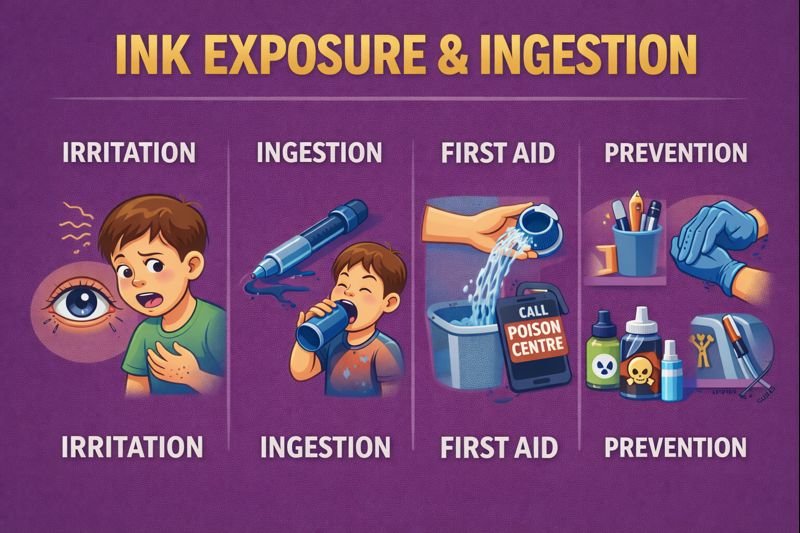
Ink that contacts the eye or skin may cause:
-
Mild burning or stinging
-
Redness or tearing (eyes)
-
Itching or irritation
-
Temporary staining of the skin or mucous membranes
Rinsing with cool running water helps remove ink. Most household inks do not cause long-term complications, though health care advice can be helpful if irritation persists or vision becomes blurry.
Ingestion of ink from pens or markers
Accidental ingestion—especially among children—is the most common form of ink exposure. Key points include:
-
Small amounts typically cause no serious effects
-
Larger amounts may cause oral staining or mild nausea
-
Poison Centres can advise on next steps if ingestion is suspected
Inducing vomiting is not recommended unless directed by a health professional or Poison Centre.
Tattoo ink and permanent makeup
Tattoo and cosmetic inks are different from household pen inks. These products may contain a wider variety of pigments and additives, some of which are regulated for topical use while others may not be. Studies continue on long-term reactions to injected pigments.
Professionals performing tattoos or permanent makeup can provide information about the inks they use and any associated safety considerations. Individuals making cosmetic decisions may consider asking about product ingredients as part of informed consent.
Prevention & workplace considerations
Exposure can be minimized by:
-
Storing pens and inks out of reach of young children
-
Supervising school and daycare environments
-
Using workplace PPE if handling bulk inks or solvents
-
Labeling and separating cosmetic inks from industrial inks
-
Rinsing promptly if accidental skin or eye contact occurs
FAQ
Is ink poisonous if swallowed?
Small accidental amounts from pens or markers are generally considered low-risk. Larger quantities may cause nausea or staining of the mouth. Poison Centres can provide guidance on a case-by-case basis.
Can ink damage the eye?
Most household inks cause temporary irritation. Rinsing with cool water is commonly recommended. Seek advice if pain, blurred vision, or persistent redness occurs.
Are tattoo inks the same as pen inks?
No. Tattoo inks and permanent makeup pigments differ in composition and are designed for injection into the skin. Their safety considerations are more complex.
Can ink stains harm the skin?
Ink can temporarily stain the skin but typically does not cause long-term damage. Mild irritation may occur.
Should vomiting be induced if ink is swallowed?
Vomiting should not be induced unless directed by a health professional or Poison Centre, as guidance depends on the situation and amount ingested.
Educational note
This information supports general first aid and exposure awareness in homes, schools, and workplaces. For specific concerns or ingestions, Poison Centres or health professionals can provide individualized guidance.
About The Author

Mark Kascha
Certified First Aid Instructor Trainer with 30+ years of real-world experience, including lifeguarding, workplace emergency response, and first aid program development across Canada. Has worked with WorkSafeBC, WSIB, and Manitoba Health.
👉 [View full credentials]🔗 View LinkedIn Profile
Last reviewed: March 2026