 Automated external defibrillators (AEDs) are increasingly found in workplaces, sports facilities, schools, airports, community centres, and other public settings. AEDs support rapid response during sudden cardiac arrest, and their presence reflects a growing awareness of community and workplace health.
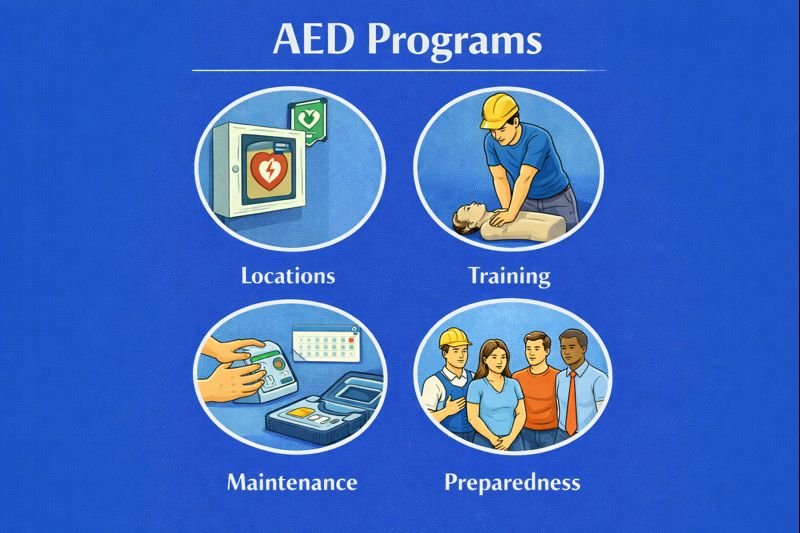
Beyond having the device available, AED programs involve planning, maintenance, training, and coordination so responders know where equipment is located and how to use it.
Relevance in Canadian Workplaces & Public Health
Many Canadian workplaces prioritize occupational health and safety, including emergency preparedness. AED accessibility aligns with broader first aid programs that may include CPR training, emergency communication plans, and incident readiness.
Scenario (Mild & Realistic)
A large office building installed AEDs on each floor along with clear signage. During a health and safety drill, employees practised locating the devices and reviewed first aid awareness. Staff noted that simply knowing where AEDs were placed increased confidence in responding to a real emergency.
Why Organizations Consider AED Programs
Organizations may explore AED programs for reasons such as:
1. Preparedness & Incident Readiness
AEDs complement first aid and CPR training by making life-saving tools accessible before emergency responders arrive.
2. Staff Education & Confidence
In workplaces with high foot traffic or diverse activities, AED awareness and CPR familiarity support a faster and calmer response during emergencies.
3. Maintenance & Visibility
AEDs need:
-
Routine checks
-
Accessible placement
-
Clear signage
-
Updated pads and batteries
Good placement strategies ensure the devices are easy to locate when time is critical.
4. Consistency Across Locations
Organizations with multiple sites—such as schools, recreation facilities, offices, or retail—may unify training and equipment maintenance for consistent response.
5. Community Safety
Public venues gain added value by contributing to community health initiatives and reducing response time for sudden cardiac arrest events.
Components of an Effective AED Program (Awareness-Based)
An AED program often emphasizes:
-
Accessible and visible AED locations
-
Staff familiar with CPR and AED basics
-
Mapping or signage for quick retrieval
-
Routine equipment checks
-
Clear emergency communication procedures
-
Integration into broader first aid planning
These components help ensure AEDs are useful not only in principle, but in practice.
AEDs in Public Venues
Beyond workplaces, AEDs are now commonly found in:
-
Gyms and arenas
-
Schools and universities
-
Airports and transit hubs
-
Shopping centres
-
Hotels and convention spaces
-
Theatres and recreation facilities
Public access expands the likelihood that bystanders can support response before medical services arrive.
FAQ
Do AEDs require medical training to operate?
Most AEDs provide voice or visual prompts. Training increases confidence and familiarity but is not required to activate many public access units.
Why are AEDs placed in non-medical environments?
Sudden cardiac arrest can occur anywhere. AED placement reduces delays in care before paramedics arrive.
Do AEDs replace CPR?
No. CPR maintains circulation, while an AED assesses rhythm and may advise a shock. Both are components of emergency response.
Are AEDs part of first aid programs?
Many workplaces integrate AED awareness into CPR and first aid training for a coordinated approach.
Educational Note
This article provides public and workplace education about AED program awareness, preparedness, and emergency planning. Needs vary across settings, and health and safety professionals can guide implementation within larger first aid programs.
About The Author

Mark Kascha
Certified First Aid Instructor Trainer with 30+ years of real-world experience, including lifeguarding, workplace emergency response, and first aid program development across Canada. Has worked with WorkSafeBC, WSIB, and Manitoba Health.
👉 [View full credentials]🔗 View LinkedIn Profile
Last reviewed: March 2026