
 What Is a High Ankle Sprain?
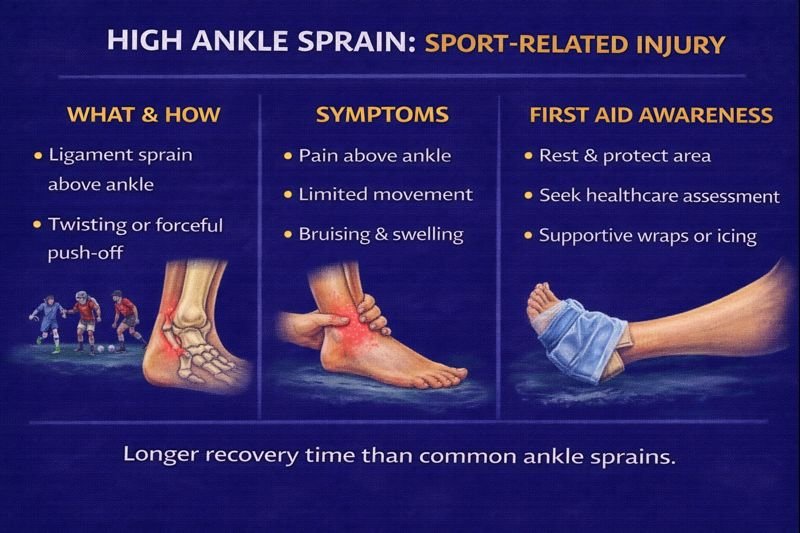
A high ankle sprain involves the ligaments connecting the two long bones of the lower leg just above the ankle. These ligaments (the syndesmosis) help stabilize the ankle during running, pivoting, and jumping. Unlike the more common “low ankle sprain,” high ankle sprains can be slower to heal and may limit return to activity for weeks to months.
Relevance for First Aid & Active Workplaces
High ankle sprains are commonly seen in sports such as football, soccer, basketball, skiing, and hockey. They may also occur in workplaces where sudden twisting, uneven ground, or jumping/lifting tasks are performed. Awareness of strains helps ensure timely rest, protection, and assessment.
Scenario: Mild & Realistic
During a recreational basketball game, a player landed awkwardly after a rebound and felt pain above the ankle. They stopped playing, iced the area, and arranged a medical assessment. The team coach modified conditioning drills for several weeks until the player could return safely.
How High Ankle Sprains Happen
High ankle sprains usually involve:
-
Twisting or outward rotation of the foot
-
Abrupt directional change
-
Forceful landing from a jump
-
Collision with another player
-
Stepping on another player’s foot
-
Ski or skate-related torque
Because these ligaments stabilize the ankle under load, injuries often occur at higher speeds or with more force than low ankle sprains.
Who Is at Higher Risk?
Activities and sports with sudden acceleration, cutting, or downhill load may increase risk, including:
-
Football
-
Soccer
-
Basketball
-
Hockey
-
Downhill skiing
-
Wrestling or field sports
-
High-intensity fitness and agility training
Symptoms
Signs vary but may include:
-
Pain above the ankle, especially with twisting
-
Pain when squeezing the lower leg
-
Swelling or bruising
-
Reduced ankle movement
-
Difficulty bearing weight or walking
-
A “pop” sensation at moment of injury in some cases
Healthcare professionals may use imaging to differentiate high ankle sprains from fractures or other ankle injuries.
Grading Severity (Common Clinical Language)
High ankle sprains are often described in three grades:
-
Grade 1: Ligament stretching and irritation
-
Grade 2: Partial tear with increased discomfort and instability
-
Grade 3: Complete tear; may require longer recovery and medical intervention
Recovery timelines depend on grade, sport demands, and medical management.
First Aid Awareness & Early Considerations
Public first aid programs commonly highlight:
-
Protecting the area from further strain
-
Resting from weight-bearing activities as needed
-
Elevating the ankle when possible
-
Using supportive wraps if advised
-
Seeking medical assessment for inability to walk, prolonged swelling, or suspected higher-grade injury
Healthcare professionals guide imaging, rehabilitation, and return-to-sport timelines.
Long-Term Considerations
High ankle sprains may take longer to heal than low ankle sprains and may require:
-
Graduated rehabilitation
-
Strength and balance training
-
Sport-specific conditioning
-
Professional guidance for return to play
Untreated or misdiagnosed sprains may lead to persistent pain or instability.
Prevention Strategies
Risk reduction may include:
-
Proper footwear and sport-specific equipment
-
Surface and training variation
-
Strengthening of lower leg and foot muscles
-
Balance and proprioceptive exercises
-
Early reporting of ankle discomfort
-
Avoiding rushed return to sport after injury
FAQ — High Ankle Sprains
1. Are high ankle sprains more serious than low ankle sprains?
They often require longer recovery because the injured ligaments stabilize the leg bones during high-force motions.
2. Can someone walk with a high ankle sprain?
Sometimes, but weight-bearing may be painful. Walking ability alone doesn’t determine severity.
3. How long does recovery take?
Timelines vary by grade, sport, and medical guidance. Some athletes return in weeks; others require months.
4. Why are high ankle sprains missed sometimes?
Symptoms appear higher on the leg, not on the ankle itself, which may delay recognition.
5. Which sports see this most?
Football, soccer, basketball, skiing, and hockey are common examples.
Educational Note
This article supports public education on ankle sprains, first aid awareness, workplace/sport relevance, and injury prevention. Healthcare professionals determine diagnosis, treatment, and rehabilitation plans.
About The Author

Mark Kascha
Certified First Aid Instructor Trainer with 30+ years of real-world experience, including lifeguarding, workplace emergency response, and first aid program development across Canada. Has worked with WorkSafeBC, WSIB, and Manitoba Health.
👉 [View full credentials]🔗 View LinkedIn Profile
Last reviewed: March 2026