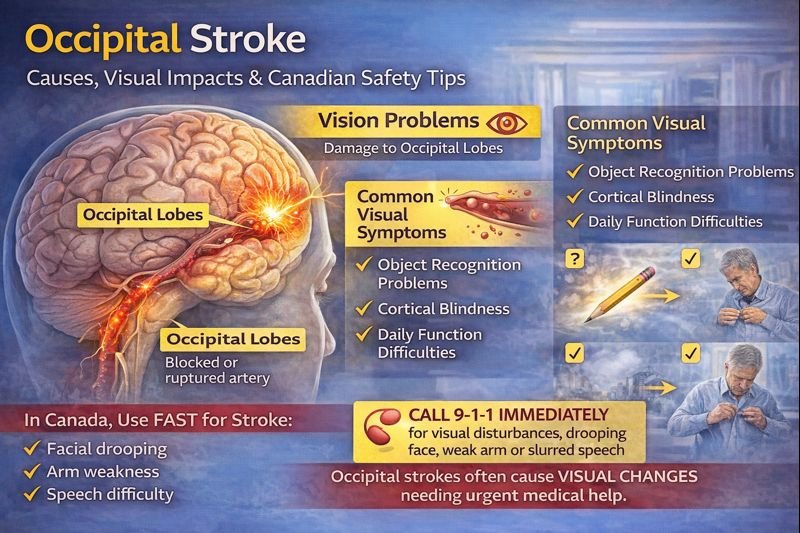
An occipital stroke occurs when the occipital lobes at the back of the brain are damaged due to a reduction in oxygenated blood — most commonly caused by a blocked or ruptured artery. Damage to this region affects visual processing, and symptoms can vary depending on the location and severity of the stroke.
Learning to recognize early signs of stroke and understanding its long-term effects is important for health emergencies, workplace safety planning, and first aid/CPR training in Canada.
What Does the Occipital Lobe Do?
The occipital lobe acts as the brain’s visual processing centre. It:
✔ Stores visual information
✔ Helps identify shapes, colours & faces
✔ Supports object recognition
✔ Interprets the environment
Damage disrupts how information from the eyes is interpreted—even if the eyes themselves function normally.
Symptoms & Functional Impacts
Object Recognition Problems (Visual Agnosia)
If the front region of the occipital lobe is damaged, individuals may:
-
See objects but struggle to identify or name them
-
Describe an item’s appearance but not its purpose
-
Fail to recognize familiar faces until hearing a voice
Cortical Blindness
Cortical blindness occurs if both occipital lobes are damaged. Unlike traditional blindness:
-
The eyes still function
-
Visual input reaches the brain
-
The brain cannot interpret the image
Some individuals are unaware of their blindness, leading to safety concerns during daily activities.
Daily Function & Rehabilitation
Most occipital strokes do not cause physical paralysis, but they can impede daily routines due to visual processing deficits. This may affect activities such as:
-
Cooking or eating independently
-
Getting dressed
-
Reading or writing
-
Driving
Recovery varies widely. Some visual function may return as the brain heals or re-routes processing to other regions. Occupational therapy is often used to retrain daily skills.
Connection to First Aid & Stroke Response
Occipital strokes share the same emergency profile as other strokes — rapid recognition and activation of emergency medical services is vital.
In Canada, bystanders should use FAST as a quick screening tool for stroke:
F – Facial drooping
A – Arm weakness
S – Speech difficulty
T – Time to call 9-1-1
Note: Visual disturbances may also appear during occipital strokes and are another reason to seek help promptly.
Learning CPR and emergency first aid ensures more Canadians are ready to respond during time-critical emergencies, including suspected stroke scenarios.
Canadian Healthcare Considerations
In Canada, stroke care is typically coordinated through:
-
Emergency departments
-
Stroke units
-
Neurology clinics
-
Occupational & vision rehabilitation services
Driving restrictions, return-to-work planning, and home safety adjustments may apply depending on visual impact.
Safety & Education Disclaimer
This post is for general health education only and is not a substitute for medical diagnosis, emergency care or professional treatment.
If stroke is suspected: Call 9-1-1 immediately.
For non-emergency medical concerns, consult a licensed Canadian healthcare professional.
About The Author

Mark Kascha
Certified First Aid Instructor Trainer with 30+ years of real-world experience, including lifeguarding, workplace emergency response, and first aid program development across Canada. Has worked with WorkSafeBC, WSIB, and Manitoba Health.
👉 [View full credentials]🔗 View LinkedIn Profile
Last reviewed: March 2026