 What are back spasms?
Back spasms are sudden, involuntary tightening of muscles in the back, often causing pain and stiffness. They can occur during or after physical activity — including running — and may relate to muscle fatigue, strength imbalances, or previous injury.
Canadian workplace & first aid relevance
Back discomfort can affect everyday movement, workplace tasks, lifting, and recreation. Understanding contributors to back spasms can support injury prevention, activity planning, and safe participation in sports or physically demanding jobs.
Scenario: Run-induced back spasm
After increasing training volume for a charity run, an employee developed a tight, painful spasm in the lower back later that evening. Light movement and stretching helped ease discomfort, and they followed up to review posture, footwear, and strengthening exercises with a clinician.
Common contributing factors
Muscle imbalance & alignment
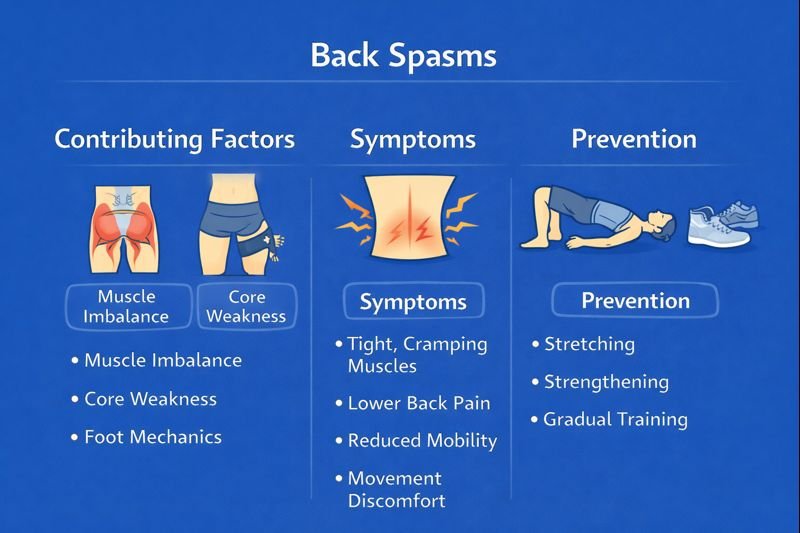
Back spasms can occur when certain muscle groups overpower others. For example:
-
Stronger quadriceps compared to glutes can tilt the pelvis forward
-
Weak abdominal or back muscles can reduce spinal support
These imbalances place additional load on the lower back, increasing the chance of spasms.
Core strength & stability
The “core” includes abdominal, back, glute, and leg muscles. When these muscles are weak or fatigue easily, the spine may not be well supported during running, lifting, or prolonged standing.
Foot mechanics & footwear
Foot posture (e.g., pronation or supination), arch structure, or worn footwear can influence force up the kinetic chain — affecting knees, hips, and lower back. A footwear review by a clinician or running specialist may help some individuals improve comfort or form.
Training load & surface
Back spasms may be more common when:
-
Training volume increases rapidly
-
Running occurs on hard surfaces for long periods
-
Cross-training or mobility work is limited
Symptoms
Back spasms can involve:
-
Sharp or tight muscle contractions
-
Lower-back stiffness or soreness
-
Reduced ability to bend or twist
-
Pain during movement or after activity
Symptoms may resolve quickly or last several days depending on fatigue and strain.
Prevention & training considerations (educational overview)
Strategies that may help reduce back spasms include:
-
Gradual increases in running distance/intensity
-
Alternating running with low-impact cross-training
-
Stretching calves, quads, hamstrings, and back muscles
-
Strengthening glutes, hips, and core muscles
-
Monitoring footwear condition and comfort
Workplaces with physical tasks may incorporate stretching, task rotation, or ergonomic review to reduce repetitive strain.
Management & first aid awareness (non-prescriptive)
Initial approaches often focus on reducing irritation:
-
Brief rest from aggravating activities
-
Gentle mobility or stretching
-
Light heat or cold for comfort
-
Hydration after exercise
Persistent or recurring spasms may warrant clinical assessment to evaluate posture, gait, strength, or underlying conditions.
When to seek assessment
Healthcare evaluation may be useful when:
-
Spasms are frequent or worsening
-
Pain travels to the leg or causes numbness/tingling
-
Symptoms follow a fall or traumatic injury
-
Daily activities, sport, or work tasks are affected
FAQ
Are back spasms a sign of serious injury?
Usually they’re related to muscle fatigue or strain, but persistent or spreading symptoms should be assessed.
Do weak core muscles cause back pain?
Weakness can contribute by reducing spinal support, but back pain has multiple possible causes.
Can shoes cause back spasms?
Foot mechanics and footwear can influence running or workplace posture. For some individuals, supportive or updated footwear can help.
Is stretching helpful for spasms?
Gentle stretching may help some people. Abrupt or forceful stretching during a spasm may not feel comfortable.
Educational note
This post supports public and workplace awareness about back spasms, movement health, and prevention strategies. Persistent or complex symptoms benefit from professional evaluation.
About The Author

Mark Kascha
Certified First Aid Instructor Trainer with 30+ years of real-world experience, including lifeguarding, workplace emergency response, and first aid program development across Canada. Has worked with WorkSafeBC, WSIB, and Manitoba Health.
👉 [View full credentials]🔗 View LinkedIn Profile
Last reviewed: March 2026