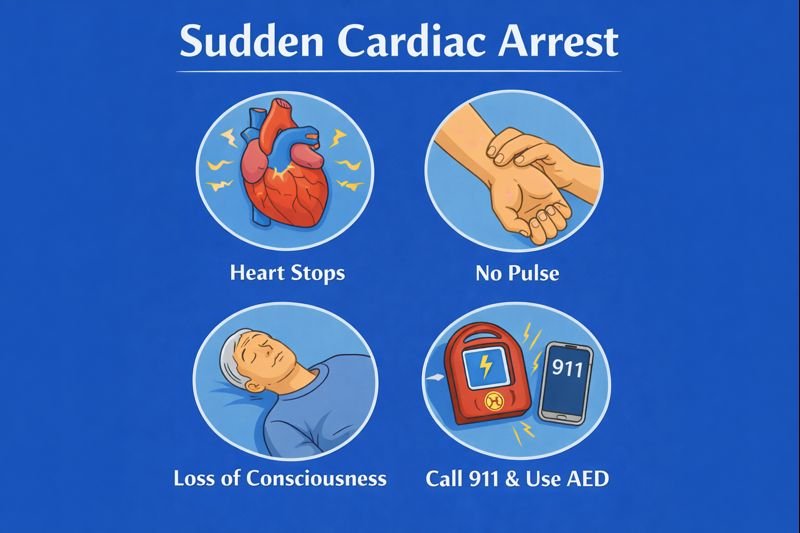
 Sudden cardiac arrest (SCA) occurs when the heart stops pumping effectively due to a disruption in its electrical system. This prevents blood from circulating to the brain and vital organs. Sudden cardiac arrest is considered a medical emergency and requires trained responders and emergency medical services.
While SCA can be serious, public awareness, early recognition, and access to first aid education can support better response in workplaces and communities.
Relevance in Canadian First Aid & Workplaces
Sudden cardiac arrest can occur in a variety of environments, including sports facilities, airports, offices, industrial sites, schools, and community centres. Many of these locations now include public access AEDs (automated external defibrillators) as part of emergency response planning. Knowing what SCA is and how it differs from other cardiac events is valuable for first aid preparedness.
Scenario (Mild & Realistic)
During a corporate conference, a participant collapsed unexpectedly. Staff called emergency services and retrieved the AED located near the front lobby. The incident prompted the workplace health and safety committee to expand CPR/AED training and awareness for employees.
Understanding Sudden Cardiac Arrest
The heart relies on an internal electrical system to regulate rate and rhythm. When this system malfunctions, arrhythmias (abnormal rhythms) can occur. Some arrhythmias interfere with the heart’s ability to pump blood. When circulation stops, SCA can occur.
SCA is different from a heart attack.
-
A heart attack involves a blockage in blood flow to heart muscle.
-
SCA involves an electrical problem that stops effective pumping.
A heart attack can sometimes lead to SCA, but the two are distinct events.
Who Can Experience SCA?
Individuals with heart conditions may have increased risk, but SCA can also occur in people without known cardiac disease. Age, genetic factors, and certain medical histories may influence risk, but SCA can appear unexpectedly in otherwise healthy individuals.
Signs & Symptoms
The most common initial sign of SCA is:
-
Sudden loss of consciousness
Additional signs may include:
-
No detectable pulse
-
No purposeful breathing or movement
Some individuals experience symptoms shortly beforehand such as:
-
Lightheadedness
-
Palpitations or racing heartbeat
-
Chest discomfort
-
Nausea
-
Shortness of breath
Role of AEDs & CPR (Awareness Only)
AEDs are designed to analyse cardiac rhythm and advise whether a shock is indicated. CPR can help maintain some circulation until trained responders arrive. Many public settings in Canada now include AEDs to support response efforts during cardiac emergencies.
CPR and AED use are taught in certified first aid courses and form part of broader emergency response systems. AEDs are intentionally designed with audio or visual prompts to guide users.
Community & Workplace Preparedness
Programs that support SCA recognition and rapid access to emergency services may include:
-
Public AED placement
-
First aid & CPR training programs
-
Emergency response planning
-
Health and safety drills
-
Clear signage and AED mapping in buildings
These measures are common in workplaces, recreation facilities, educational settings, and travel hubs.
FAQ
Is sudden cardiac arrest the same as a heart attack?
No. SCA is an electrical problem that stops pumping; a heart attack is a circulation problem involving reduced blood flow.
Do only older adults experience SCA?
While age and cardiac history can increase risk, SCA can occur at a variety of ages, including among active individuals.
Can bystanders use an AED?
AEDs are made for public access and provide voice or visual prompts. Training increases comfort but is not required to operate most devices.
Why are AEDs placed in workplaces and public areas?
Early access to AEDs is part of emergency planning aimed at improving response during cardiac emergencies.
Educational Note
This article provides public and workplace education about sudden cardiac arrest and first aid awareness. Cardiac emergencies vary, and trained health professionals and emergency responders provide advanced medical care.
About The Author

Mark Kascha
Certified First Aid Instructor Trainer with 30+ years of real-world experience, including lifeguarding, workplace emergency response, and first aid program development across Canada. Has worked with WorkSafeBC, WSIB, and Manitoba Health.
👉 [View full credentials]🔗 View LinkedIn Profile
Last reviewed: March 2026