
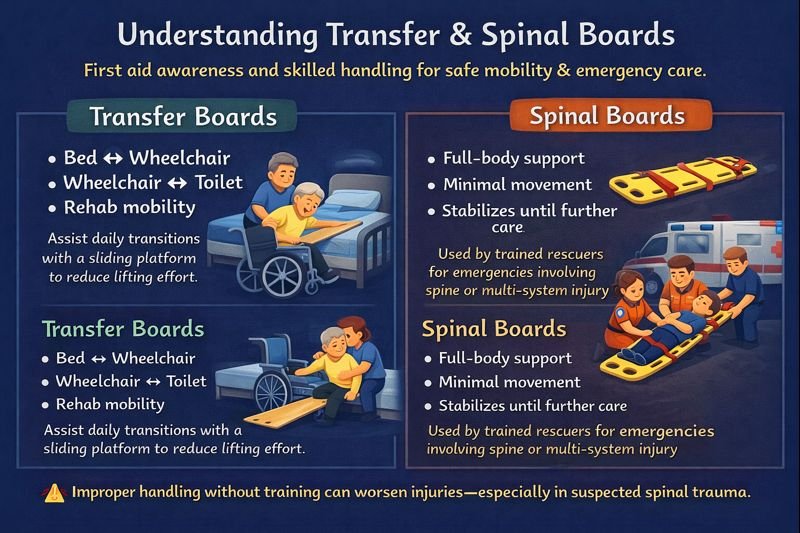
 Transfer boards and spinal boards are used to move individuals safely when they cannot move independently. These devices help reduce strain on caregivers and minimize the risk of further injury to the individual being moved.
Relevance in First Aid & Canadian Settings
Transfer tools are used in healthcare, long-term care homes, rehabilitation settings, workplaces, and emergency medical services. In community first aid education, emphasis is placed on awareness of equipment roles and the importance of trained personnel, rather than instructing the public to perform technical manoeuvres.
Scenario: Mild & Realistic
In a long-term care home, a resident with limited mobility required assistance moving between their wheelchair and bed. Trained staff used a transfer board to reduce lifting and strain, ensuring the resident remained comfortable and supported throughout the process.
Types of Boards & Their Purposes
Transfer (Transport) Boards
Transfer boards assist with everyday mobility transitions such as:
-
Bed ↔ Wheelchair
-
Wheelchair ↔ Toilet
-
Chair ↔ Vehicle (with assistance)
They bridge gaps between surfaces and allow sliding movements with less lifting effort. Transfer boards are commonly used by trained caregivers, rehab professionals, and individuals who have practiced safe technique.
Spinal Boards
Spinal boards are specialized devices used in emergencies when spine or multi-system injury is suspected. They provide:
-
Full-body support
-
Minimal movement during transfer
-
Stabilization until further medical care is available
Spinal boards are used by trained first responders and emergency medical personnel, not by untrained bystanders.
Why Training Matters
Using transfer or spinal boards safely requires:
-
Knowledge of body mechanics
-
Team communication
-
Injury awareness
-
Equipment familiarity
-
Respect for the spine and airway
Improper attempts to move an injured person without training can worsen injuries—especially in suspected spinal trauma.
Awareness of Emergency Transfer Techniques
Emergency personnel learn specialized techniques such as:
-
Log roll
-
Lift-and-slide
-
Team carries
-
Stabilization procedures
These techniques require coordinated multi-person teams, role assignments (e.g., head support, torso control, leg positioning), and a designated leader to manage timing. These procedures are not taught for untrained community use.
Everyday Mobility Transfers (Awareness Only)
In non-emergency contexts, transfer boards may support:
-
Rehabilitation programs
-
Assisted daily living activities
-
Occupational therapy mobility training
-
Reducing strain on caregivers
-
Promoting independence for some wheelchair users
Devices and setup vary by need, strength, and mobility level.
Prevention of Injury for Caregivers & Individuals
Transfer assistance can help reduce:
-
Falls
-
Shoulder strain
-
Back injuries among caregivers
-
Friction or shearing injuries to skin
-
Anxiety during movement
Workplace training programs (e.g., in healthcare or long-term care) emphasize safe lifting policies, mechanical aids, and team support.
When Professionals Should Handle Transfers
Emergency medical professionals or trained staff should conduct transfers when:
-
Injury is suspected after a fall or collision
-
Spine or neck symptoms are present
-
Pain is severe or movement is difficult
-
The individual cannot support their weight
-
The scenario involves trauma, loss of consciousness, or unknown medical status
Untrained movement can worsen injuries in these situations.
FAQ
1. Are spinal boards the same as stretchers?
No. Spinal boards are rigid devices for immobilization; stretchers are used for patient transport and may be flexible or wheeled.
2. Can family members use transfer boards at home?
Some individuals use transfer boards at home after training from rehab or occupational therapy professionals.
3. Why do emergency responders use multiple people for spinal transfers?
Teams reduce the risk of movement that could exacerbate spinal or internal injuries.
4. Do all head or spine injuries require immobilization?
Assessment is done by trained professionals based on symptoms, history, and mechanism of injury.
5. Can these devices prevent injury?
Transfer devices reduce strain and promote safer movement when used correctly.
Educational Note
This article supports public awareness about transfer and spinal boards. It does not teach operational techniques, emergency procedures, or substitution for trained medical or mobility professionals.
About The Author

Mark Kascha
Certified First Aid Instructor Trainer with 30+ years of real-world experience, including lifeguarding, workplace emergency response, and first aid program development across Canada. Has worked with WorkSafeBC, WSIB, and Manitoba Health.
👉 [View full credentials]🔗 View LinkedIn Profile
Last reviewed: March 2026